Tracing Inventory Transaction Histories Across Servers to Detect Emergent Trading Networks in Virtual Economies
Written by Viktor Günther · Jul 26, 2026
Tracing Inventory Transaction Histories Across Servers to Detect Emergent Trading Networks in Virtual Economies
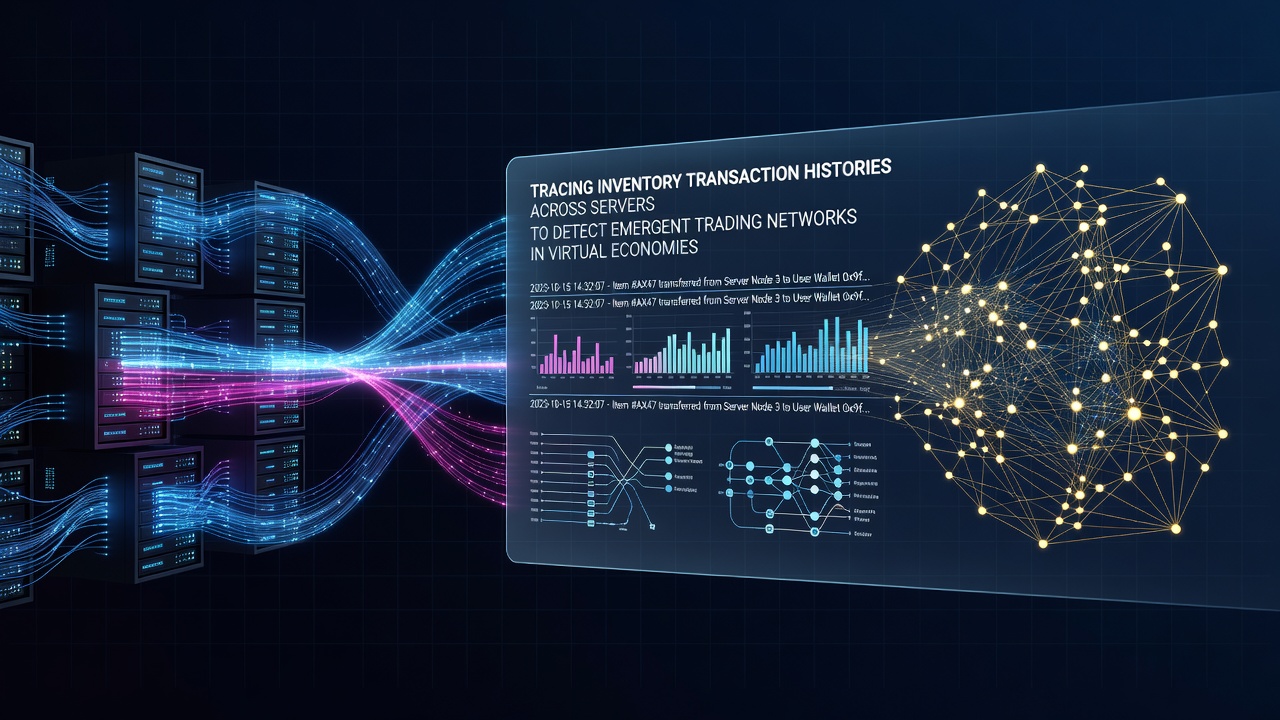
Analysts track item movements by pulling transaction logs from distributed game servers, and this approach maps how virtual goods shift between players across different instances or shards, while researchers compile timestamps, account identifiers, and item metadata to reconstruct complete histories that span weeks or months of activity.
Core Data Collection Methods
Game operators maintain centralized databases that record every trade, drop, and transfer event, yet many virtual economies operate across regional clusters where servers synchronize only periodically, so teams aggregate these records into unified timelines that reveal cross-server pathways. Data indicates that patterns emerge when analysts apply graph theory to the logs, connecting nodes that represent accounts and edges that represent completed transfers, which highlights clusters of activity that single-server views obscure. In July 2026, reports from the Canadian Competition Bureau noted increased scrutiny of such analytical techniques in digital marketplaces, and similar methods now appear in studies examining player-driven economies in large-scale titles.
Identifying Emergent Trading Structures
Observers note that repeated exchanges between the same groups of accounts often signal coordinated behavior rather than organic player interaction, and algorithms flag these repetitions by calculating frequency thresholds and volume spikes. Research shows that certain networks route rare items through intermediate accounts to obscure origin points, whereas direct peer-to-peer trades leave clearer trails. Those who've studied this process know that incorporating player movement data alongside transaction records adds another layer, because location timestamps can confirm whether an item physically traveled between regions before changing hands.
Technical Implementation Across Clusters
Engineers build pipelines that normalize log formats from heterogeneous servers, then apply entity resolution to match accounts that use different identifiers across platforms, and this step proves essential when games allow cross-progression features. Studies found that machine-learning models trained on historical transaction sets improve detection rates by learning normal trade distributions versus anomalous ones, while visualization tools render the resulting networks as interactive graphs for human review. Figures reveal that processing times drop significantly when queries run on distributed databases rather than monolithic ones, allowing analysts to examine months of data within hours.

Real-World Applications in Live Titles
Take one studio that deployed cross-server tracing in a persistent MMO during 2025, where the system identified a cluster of accounts moving high-value crafting materials through intermediary players, and subsequent manual review confirmed coordinated market manipulation. Data from the European Commission on digital single markets shows parallel interest in these monitoring practices for regulating virtual asset flows, and similar frameworks have appeared in academic papers examining player economies in sandbox games. What's interesting is how the same logs that expose trading rings also supply feedback for economy balancing, because developers adjust drop rates or trade restrictions based on observed circulation speeds.
Challenges and Refinements
Privacy regulations require anonymization of account data before analysis begins, yet this step can complicate entity resolution when multiple accounts belong to the same individual, and teams therefore combine behavioral signals such as login patterns with transaction histories to maintain accuracy. Observers note that latency between server synchronizations sometimes creates temporary blind spots, whereas batch processing at regular intervals mitigates these gaps. Research indicates that false positives decrease when analysts incorporate context from in-game events, because seasonal promotions or new content releases naturally alter trade volumes in predictable ways.
Conclusion
Cross-server transaction tracing supplies a practical method for mapping emergent networks in virtual economies, and ongoing refinements in data aggregation and graph analysis continue to expand its reach. Government bodies and research institutions track these developments because virtual asset movements increasingly intersect with broader digital market oversight, while game operators apply the resulting insights to maintain stable in-game marketplaces. The techniques remain grounded in established data practices that scale across distributed environments, and their adoption reflects the growing complexity of player-driven trading systems worldwide.