Integrating Mod Installation Order Dependencies with Save Integrity Checks to Prevent Cascade Failures in Heavily Customized Role Playing Environments
Written by Wendy Krause · Aug 25, 2026
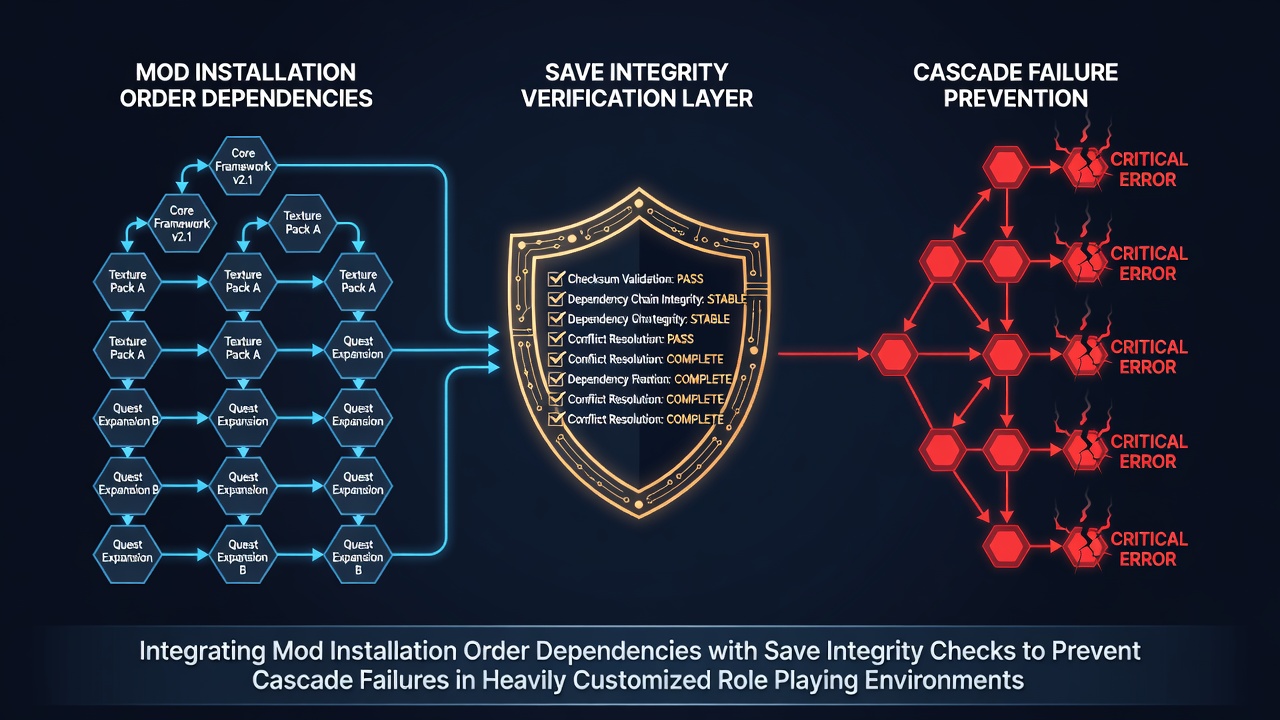
Integrating Mod Installation Order Dependencies with Save Integrity Checks to Prevent Cascade Failures in Heavily Customized Role Playing Environments
Modded role playing games rely on precise sequencing of installation files because one alteration can ripple through dozens of others when dependencies remain unchecked, and players who customize titles such as Skyrim or Fallout New Vegas frequently encounter situations where an out of sequence mod disrupts quest flags, item placements, or character stats. Data from community repositories shows that installation order errors account for a significant portion of reported save corruption cases across major titles, while researchers at institutions studying software dependency graphs have mapped how small sequencing mistakes trigger larger system breakdowns.
Understanding Mod Installation Order Dependencies
Every mod carries metadata that lists the files it overwrites and the patches it requires, yet those requirements only function correctly when the load sequence places prerequisite content ahead of dependent content. Tools developed by modding communities parse these relationships automatically, scanning header data and conflict tables to generate an optimized sequence that satisfies all declared conditions, and the process becomes more complex in environments where hundreds of modifications interact simultaneously. Observers note that automated sorters such as LOOT and its successors analyze plugin headers in real time, reordering entries whenever new content is added so that master files load before their extensions and compatibility patches sit between the mods they reconcile.
When those automated systems receive incomplete metadata, manual overrides become necessary, and users who document their adjustments maintain separate lists that record why one mod precedes another. This documentation proves valuable later when a new update arrives and forces a re-evaluation of the entire chain.
Role of Save Integrity Checks
Save files record the current state of every active modification, including form IDs, script variables, and quest stages, so any mismatch between the installed mod set and the recorded data produces immediate errors upon loading. Integrity verification routines compare the save's embedded plugin list against the currently active load order, flagging discrepancies such as missing masters or altered record counts that would otherwise cause crashes or silent data loss. Several mod managers now embed these checks directly into the launch sequence, halting the game start until conflicts receive resolution or until the player approves a temporary override for testing purposes.
Studies conducted by software reliability groups indicate that routine integrity scans reduce the incidence of cascade failures by identifying corrupted records before they propagate through the game engine's runtime systems. The checks also log every discrepancy, creating an audit trail that helps players trace which recent installation change introduced the problem.
Integration Strategies That Reduce Risk
Combining order management with save verification creates a feedback loop where the load order tool consults the save file's recorded state before applying new changes, and the integrity scanner in turn references the current order to validate each record. This two-way communication prevents situations where a newly installed mod overwrites critical data that the save still expects to find in its original location. Developers of mod management utilities have implemented shared databases that store both dependency graphs and historical save snapshots, allowing the software to simulate load outcomes before committing alterations to the active profile.
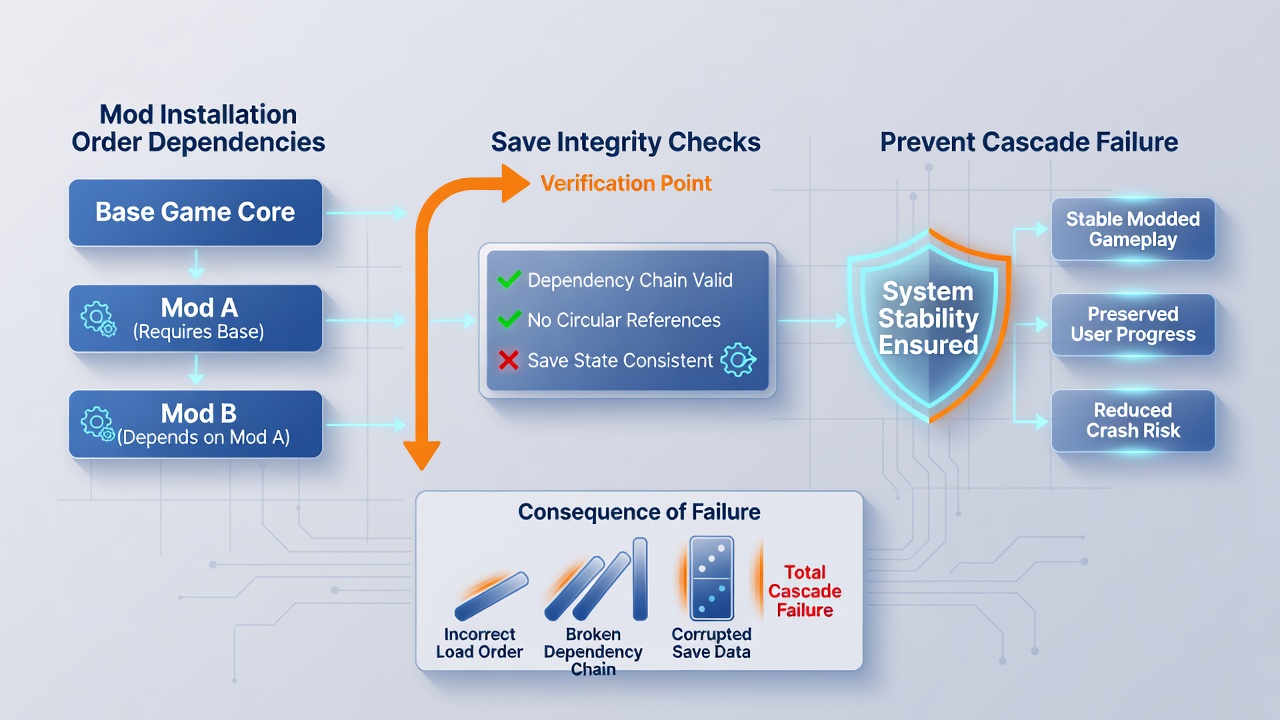
One common workflow involves exporting the current save's plugin footprint, feeding that data into the order optimizer, then running a pre-launch integrity pass that confirms every referenced record still exists under the proposed sequence. When the system detects a potential mismatch it suggests either reverting the save to an earlier backup or adjusting the order to restore compatibility. Community-maintained wikis compile lists of known problematic combinations, and those compilations receive frequent updates as new patches appear.
Developments Observed Through August 2026
As of August 2026 several widely used mod platforms released coordinated updates that embed machine learning models trained on millions of anonymized load order and save pairs, enabling the software to predict failure points with higher accuracy than rule-based systems alone. Reports from the Interactive Games and Entertainment Association in Australia highlight how these predictive features lowered support tickets related to corrupted saves in the preceding twelve months. European research consortia examining digital preservation have also contributed datasets that help mod tools recognize legacy record formats still present in older titles, reducing the chance that an ancient dependency breaks a modernized load order.
Players who maintain multiple parallel profiles benefit from these advances because the verification layer now isolates each profile's save history, preventing cross-contamination when switching between heavily customized setups. The same layer can export sanitized logs that exclude personal identifiers, allowing community analysts to refine the underlying models without compromising individual privacy.
Practical Implementation Steps
Users begin by backing up all active saves and documenting the exact mod list in its current state, then they activate the integrated verification mode within their chosen manager so that every subsequent change triggers an automatic consistency scan. Next they import any external patch lists or community rulesets that address known conflicts, allowing the optimizer to incorporate those constraints during reordering. After the new sequence stabilizes, a final integrity pass compares the revised order against each saved game to confirm no orphaned records remain. Regular rechecks after game updates or new mod releases keep the system aligned and limit the window during which cascade failures can develop.
Conclusion
Effective integration of installation order logic with save integrity verification provides a structured defense against the complex failure modes that arise in extensively modified role playing environments, and continued refinement of these combined systems supports stable play across evolving mod ecosystems. Data collected through August 2026 demonstrates measurable reductions in corruption incidents when both layers operate in tandem, confirming that coordinated dependency management and record validation together address root causes rather than symptoms alone.