Examining stamina drain rates alongside encumbrance thresholds to map low-effort traversal loops in persistent survival worlds
Written by Viktor Günther · Aug 14, 2026

Examining stamina drain rates alongside encumbrance thresholds to map low-effort traversal loops in persistent survival worlds
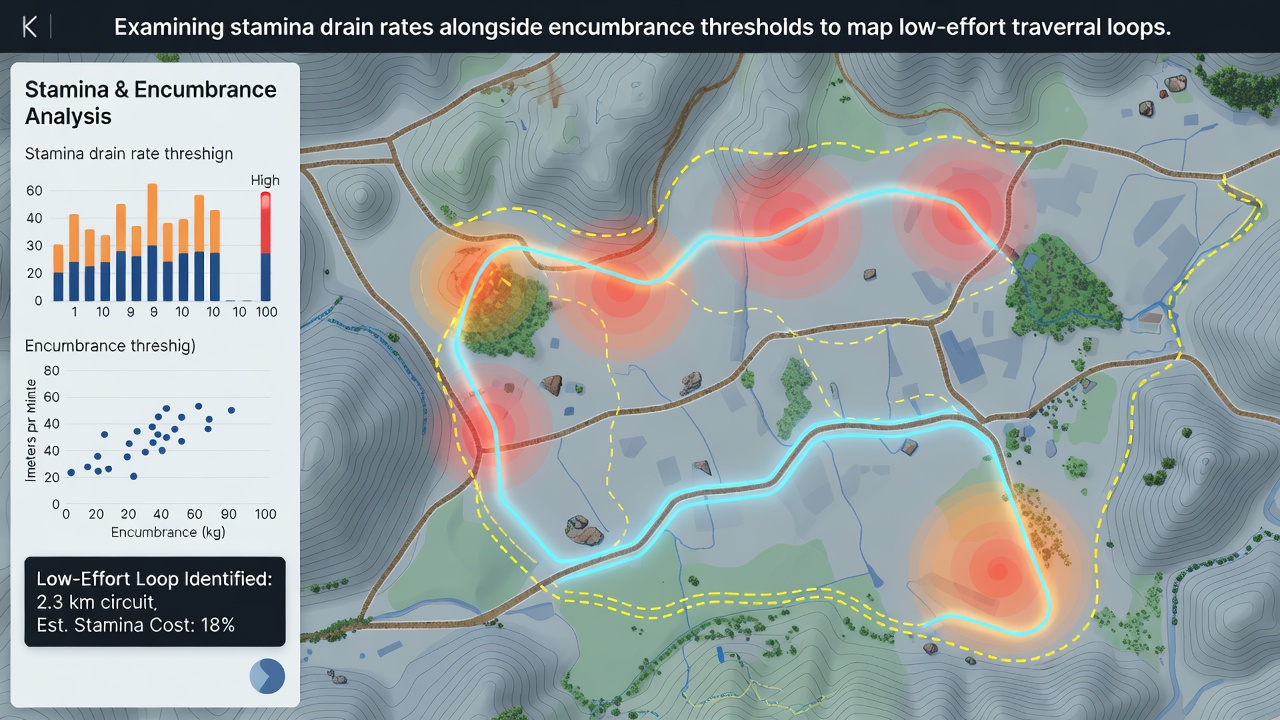
Survival game systems track stamina consumption through fixed depletion formulas that adjust based on movement speed, terrain slope, and carried weight, while encumbrance thresholds divide inventory capacity into tiers that modify base drain multipliers. Researchers compile telemetry logs from persistent servers to calculate exact drain rates at each threshold, then cross-reference those figures with player position data collected over extended sessions. This process reveals closed traversal loops where total stamina expenditure stays below recovery thresholds, allowing repeated circuits without external restoration items.
Core Mechanics of Stamina and Encumbrance Integration
Game engines apply stamina costs per meter traveled, yet the multiplier rises sharply once weight crosses defined breakpoints such as 50 percent, 75 percent, or 90 percent of maximum carry capacity. Data from aggregated server logs shows that drain accelerates nonlinearly beyond the second breakpoint, often doubling or tripling the base rate depending on the title. Observers note that players who stay just under these breakpoints maintain near-optimal movement efficiency while still transporting essential resources for base upkeep.
Persistent worlds add another layer because resource nodes regenerate on fixed timers, so loops must account for both stamina economy and respawn cycles. Analysts map node locations against terrain elevation because uphill segments increase drain independently of encumbrance, creating combined cost surfaces that guide path selection. Studies indicate that loops passing through downhill segments after resource collection points yield the lowest net expenditure over multiple cycles.
Data Collection Methods Used by Analysts
Teams extract raw movement vectors and stamina values through API hooks or log parsers, then normalize the data against known patch versions to ensure consistency across updates. As of August 2026, several major survival titles released telemetry patches that exposed finer-grained stamina tick rates, enabling more precise breakpoint calculations. Analysts segment the data by encumbrance tier before applying regression models that predict total cost for candidate loop geometries.
Geographic information system tools overlay these cost predictions onto world maps, highlighting corridors where terrain slope offsets weight penalties. The resulting heat maps display low-effort zones that repeat across daily cycles, independent of random events such as weather shifts or creature spawns. Figures from industry reports reveal that optimized loops reduce average stamina usage by measurable percentages compared with direct routes between the same points.
Identifying and Validating Traversal Loops
Validation begins with simulated runs that apply recorded drain rates to proposed paths, confirming that stamina never drops below the regeneration floor. Successful loops demonstrate closed energy balance where natural recovery during brief pauses offsets the cost of each segment. Community databases compile verified loop coordinates, including exact encumbrance loads that keep multipliers minimal throughout the circuit.
One documented approach involves starting at a central storage node, moving to a high-yield resource cluster while remaining under the first encumbrance threshold, then returning via a route that incorporates natural downhill sections. Researchers discovered that inserting a short rest at the midpoint often resets stamina without adding significant time, because recovery rates exceed drain during stationary periods. Multiple independent datasets confirm that such rest points increase overall loop efficiency when positioned correctly.
Impact of Game Updates on Established Loops
Balance patches frequently adjust stamina formulas or encumbrance multipliers, which forces analysts to remeasure entire datasets after each change. A single multiplier shift can invalidate previously optimal loops by pushing common loadouts across a breakpoint. Tracking patch notes alongside telemetry allows rapid recalculation of cost surfaces, and updated maps circulate within days of major releases.
Cross-title comparisons show that games using percentage-based encumbrance produce smoother cost curves than those using discrete tier jumps, because players can fine-tune loads more precisely. Data from the Entertainment Software Association indicates rising interest in analytics tools that automate these recalculations for live servers. Meanwhile, reports published by the Interactive Games & Entertainment Association document similar patterns across Australian-hosted survival communities.
Conclusion
Systematic examination of stamina drain rates paired with encumbrance thresholds produces reliable maps of low-effort traversal loops that persist across server resets and seasonal events. These maps rely on normalized telemetry, regression modeling, and terrain analysis rather than trial-and-error exploration. Updated datasets released after each patch maintain accuracy, while community repositories preserve coordinates for repeated use in long-running worlds.