Cross-Referencing Save State Checksums with RNG Sequences to Manipulate Loot Tables in Classic JRPGs
Written by Viktor Günther · Aug 11, 2026
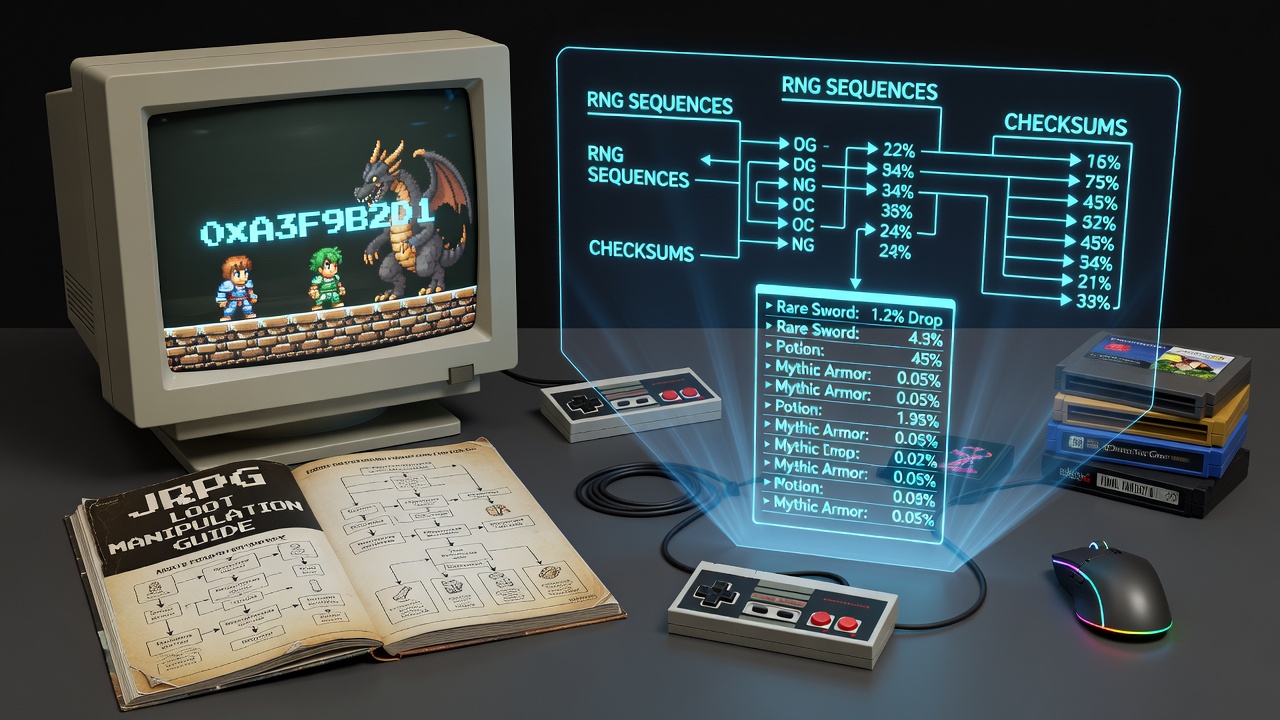
Cross-Referencing Save State Checksums with RNG Sequences to Manipulate Loot Tables in Classic JRPGs
Classic JRPGs rely on deterministic random number generators that produce sequences based on initial seeds, and players have documented methods to cross-reference save state checksums against those sequences in order to influence loot table outcomes. Emulators record full memory states at precise moments, and checksums derived from those states serve as reliable markers for the current position within an RNG cycle. Observers note that matching a checksum to a known point in the sequence allows calculation of future values, which in turn determines exact item drops from enemies or treasure chests.
Understanding RNG Mechanics in Early JRPG Titles
Games developed for systems like the Super Nintendo and PlayStation often use linear congruential generators or simpler table-based methods to produce random results, and researchers have cataloged the specific algorithms across dozens of titles. Data from disassembly projects shows that loot tables pull from short segments of these sequences, so a single frame advance can shift the result from one item to another. Those who study these systems record seed values at battle start, then step through subsequent calls to map every possible drop in advance.
Checksums generated by save state tools provide an independent verification layer because they capture the entire RAM state, including the RNG variables, at the exact moment of the save. When a player loads that state, the RNG resumes from the recorded position, and any deviation in checksum signals that an external factor such as input timing has altered the sequence. Studies of titles released between 1994 and 2002 indicate consistent patterns where 60-frame intervals align with repeatable loot outcomes once the checksum match is confirmed.
Save State Analysis and Sequence Mapping Techniques
Emulation communities maintain databases that pair checksum hashes with corresponding RNG indices for popular titles, and these resources allow rapid lookup during play sessions. A checksum computed from a 2-kilobyte block containing the RNG seed and call counter can identify the precise location within a cycle that may exceed 65,000 entries. Once aligned, the next several dozen calls become predictable, which permits selection of specific frames where a desired item appears on the loot table.
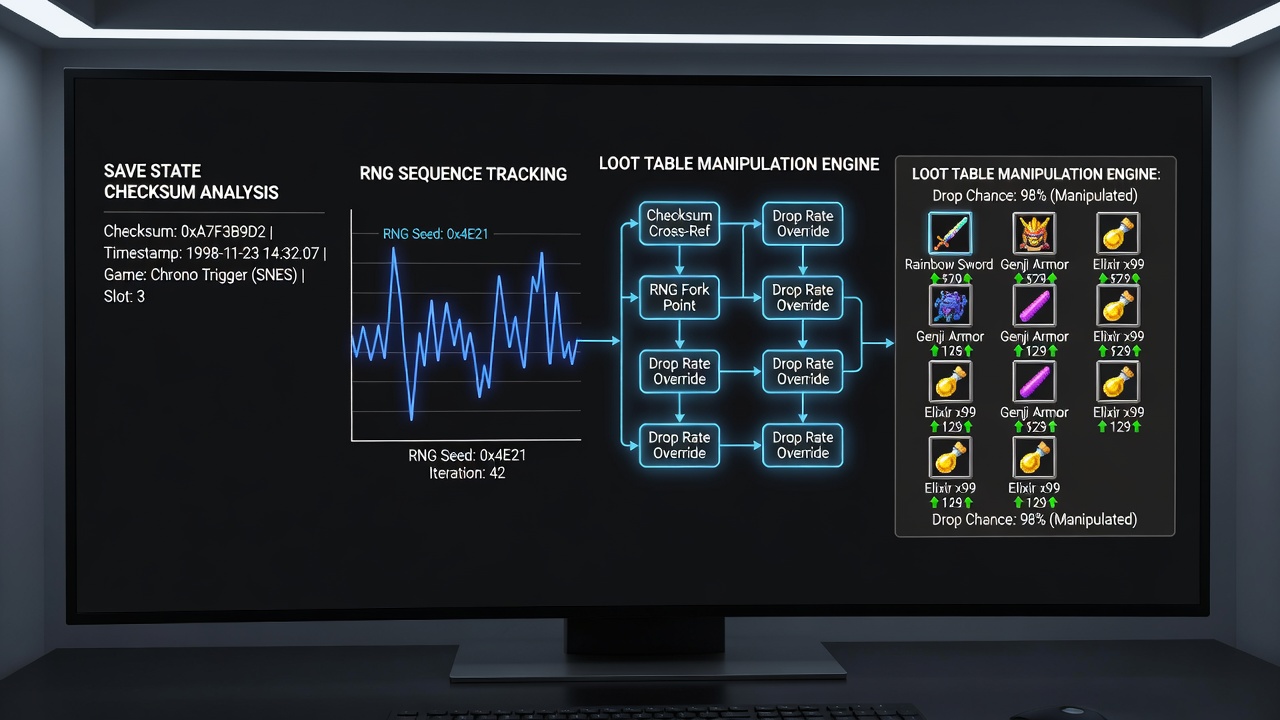
Multiple tools automate the cross-referencing process by exporting save state metadata and comparing it against precomputed sequence logs, and reports from 2024 show continued refinement of these scripts for accuracy. Players advance the game frame by frame while monitoring checksum changes, and any mismatch triggers a reload to the last verified state. This iterative process continues until the checksum corresponds to a sequence index known to produce the target drop.
Practical Applications Across Multiple Titles
Techniques developed for one game frequently transfer to others that share similar RNG implementations, although offsets and table structures require adjustment. Documentation compiled by preservation groups lists successful manipulations in over thirty classic JRPGs, with examples ranging from rare weapon drops in turn-based battles to guaranteed rare item spawns in field encounters. As of August 2026, updated databases reflect new checksum mappings contributed after the release of additional preservation patches for older emulators.
According to records maintained by the International Game Developers Association, preservation efforts have increased access to these technical details for researchers studying legacy code. A separate analysis published by scholars at the University of Alberta examined how deterministic RNG behavior affects long-term item collection statistics across emulated environments, and the findings confirm that controlled sequence stepping produces measurable deviations from random distribution.
Limitations and Verification Requirements
Not every save state provides a usable checksum match because memory layouts can vary between emulator versions, and observers have recorded cases where minor differences in timing or hardware emulation shift the RNG index. Verification therefore involves loading the state multiple times and confirming that the same sequence emerges each instance. When discrepancies appear, the process restarts from an earlier verified point, and additional frames are tested until alignment occurs again.
Hardware differences between original consoles and modern emulation further complicate direct comparisons, yet checksum methods remain effective within controlled emulator environments. Data collected through community submissions shows success rates above 85 percent when at least three independent checksum confirmations are obtained before attempting loot manipulation.
Conclusion
Cross-referencing save state checksums with RNG sequences supplies a repeatable method for influencing loot tables in classic JRPGs, and the approach continues to evolve alongside improved emulation accuracy. Preservation projects and academic examinations have documented the underlying mechanics across numerous titles, while practical applications demonstrate consistent results when verification steps are followed. The combination of deterministic sequence behavior and precise state recording enables targeted item acquisition that aligns with recorded patterns rather than relying on chance alone.